
Unmuting a Life
How a 62-year-old woman ended 40 years of daily drinking without cravings or depression.


A year ago, she mumbled, “Someone has turned down the volume to my life. It’s like my life is on mute.”
Twenty-five years of practicing internal medicine have set my expectations correctly: chronic problems get worse. When a 62-year-old woman drinks two shots of whiskey every night for 40 years to deal with life, I expect her to continue. Continue to drink. Continue to age swiftly. Continue to advance all of her chronic diseases. When she said her desire for alcohol vanished and she’d suddenly became sober, I did not believe her. Yet, she had stopped drinking alcohol without cravings and moved on to a better life. How?
The Muted Life: Wiring for Chaos
Mrs. Muted grew up in an abusive home where her mother often yelled, “You escaped from a broken rubber!” These words formed a worthless self-image and wired her brain for emotional chaos. She felt alive only when extreme disorder existed. By 12, she expected her mother to be drunk every day. By 14, Mrs. Muted drank every day.
For the next half century, alcohol was her friend, lasting longer than both marriages and helping her push away the symptoms her body generated, trying to warn her of brewing underlying health problems. She treated her stressors with a drink as her chronic medical problems grew. Headaches became migraines. Her upset stomach escalated to irritable bowel syndrome. Her poor nourishment became chronic fatigue. By age 18, these diagnoses littered her medical chart. For forty years, she used booze to push away life. This tool drained her body just like it would any other person. Mrs. Muted lived her life in a fog. She watched from afar where colors faded, and sounds were distant.
And then, while listening to one of my YouTube videos, these words pierced the fog and caught her attention: “When the body’s mitochondria are damaged, patients feel like their life is muted.”
Mrs. Muted’s husband poured equal shots of whiskey again that night. For a decade, they had joined in their ritual to unwind and commiserate. Tonight, they identified their enemy: Broken mitochondria. And a newfound hero: A ketogenic diet.
Dabbling in Keto
She found my YouTube channel and spent months guiding herself through a committed ketogenic diet. She followed my rule: Measurement is key. Success follows those who produce ketones first thing in the morning. How do you know if you have ketones in the morning? You must measure. The best measurement is through blood testing. She did all the things. Bought the meter. Wrote down the numbers and changed behavior based on her metrics. She wanted a better brain, and indeed she found one using this method.
At age 14, amidst the trauma of an abusive home, Mrs. Muted began wiring the Ventral Tegmental Area (VTA) in her brain. Like all of us, whenever we feel joy, the VTA supplies bursts of dopamine to reward that pleasure-producing behavior. Alcohol delivered dopamine, at first.
Years of indulging in this joy-maker led to a different result. The chaos and stress hijacked the plan and built one path to pleasure instead of many. This left her with one coping mechanism for life instead of a half dozen good options. Unlike normal neural pathways, which are delicate threads in our brains, her addiction pathway using alcohol became a thick, industrial-strength cable by comparison. Every time she drank to escape, she added another layer of reinforcement to this wire. Over the years, instead of joy from drinking, her brain felt relief.
At the age of 62, Mrs. Muted suffered from anhedonia. She could not feel happiness. Years of grime coating her cells caused problems in her body. The grime came from microscopic inflammation of the cells. Each time the cell performed its duties, debris accumulated as a product of the cellular function. In her brain, that function was the production and delivery of neurotransmitters such as dopamine. Cellular debris removal happens regularly in healthy people. The process is called autophagy and is triggered with a drop in blood sugar and a rise in blood ketones. Years without meaningful ketones suffocated Mrs. Muted’s brain cells, resulting in minimal dopamine production. Low dopamine, combined with hyper-dependence on alcohol to lift her mood, resulted in anhedonia. Months of a ketogenic diet erased several of her symptoms, including some of the brain fog, but not enough to restore joy.
The Impasse: Why Keto Wasn’t Enough
Months of ketosis improved her physical symptoms, too. In December 2024, Mrs. Muted weighed 186 pounds. Using the self-guided keto principles, her average blood sugar dropped from a pre-diabetic 122 mg/dL down to a healthy 111 mg/dL, and she lost 15 pounds in those four months.
I’m rather impressed she had the success she did. Two shots of whiskey every night would sabotage the ketogenic numbers of every patient I see. Indeed, Mrs. Muted’s progress hit a hard stall. Alcohol derailed her metabolism. She battled intense carbohydrate cravings and a daily dependence on whiskey. Because she was unable to overcome these deeply entrenched addictive pathways, she regressed and gained the 15 pounds back.
But despite the returned weight, Mrs. Muted kept producing ketones, and her average blood sugar remained low, triggering autophagy. Her marginally improved blood chemistry fixed many things. She no longer teetered on the edge of diabetes; her energy improved; her sleep improved; her focus improved, but not enough brain repair to turn the sound back up.
21-DMK
She joined our live bootcamp, where we teach the most advanced form of the ketogenic diet. For 21 days we kick metabolisms into the next gear. Our students replace many mitochondria in those 3 weeks.
The first week, they follow a strict ketogenic menu, never exceeding 20 total grams of carbohydrates a day. The second week kicks off with the first metabolic challenge: sardines and nothing else on the menu for 72 hours. Week three challenges the students to a water fast. Everyone makes it 36 hours. Mrs. Muted made it 72 hours.
The chart below shows the average blood sugar for all 200 students in her class.
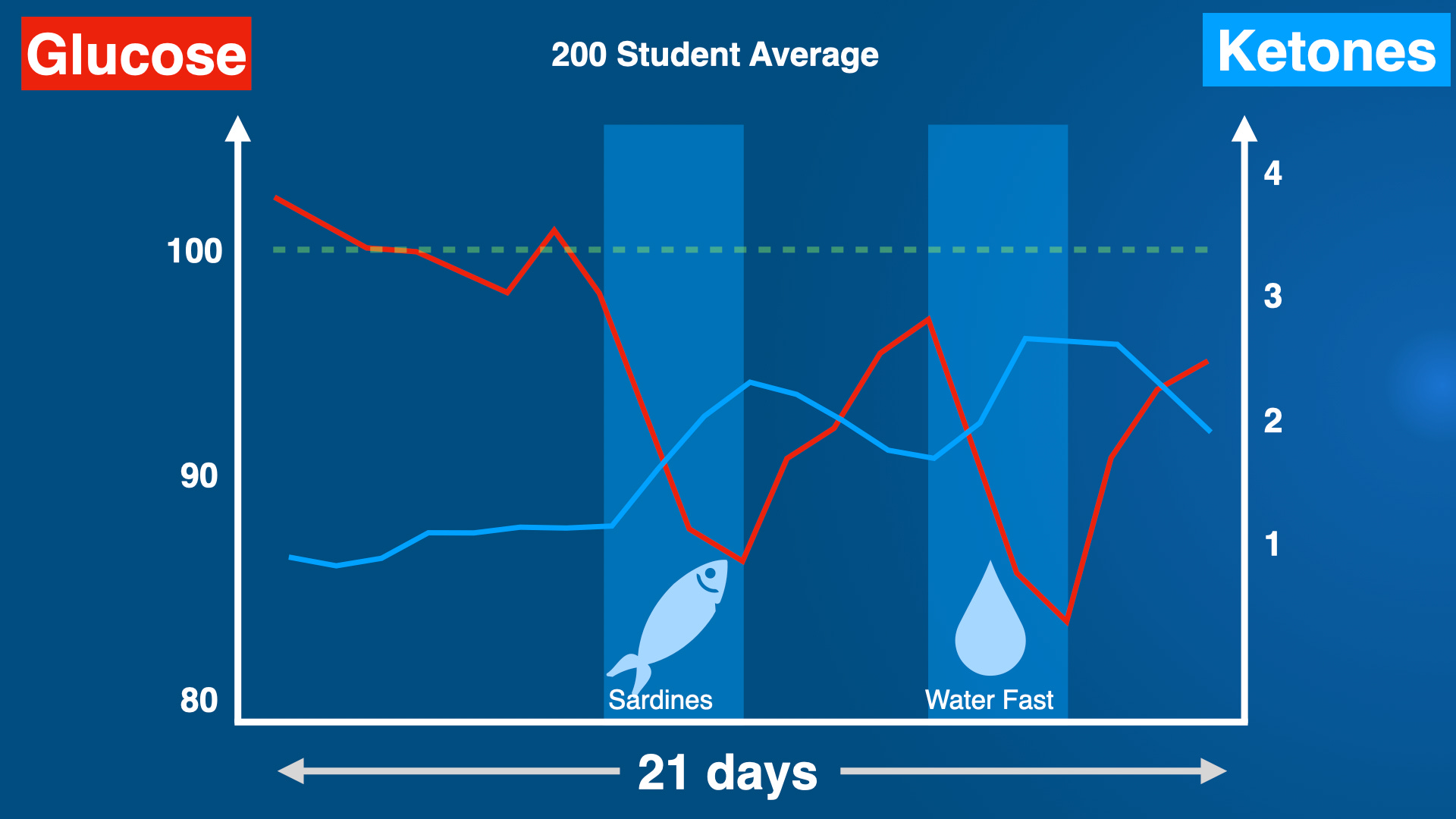
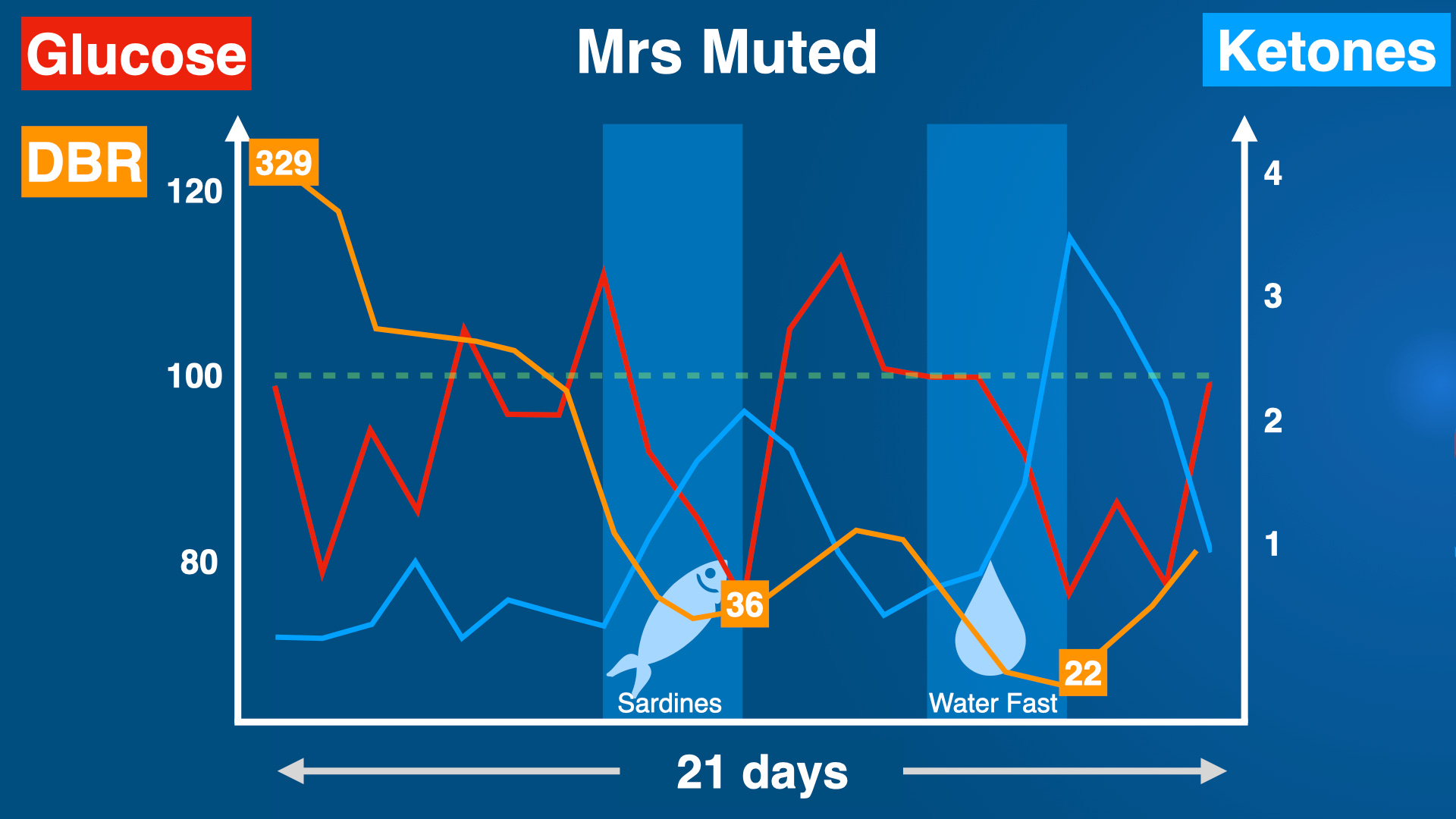
Study the difference between the class average and Mrs. Muted’s in the diagrams.
The volatility of her glucose numbers reflected a problem. Thanks to her past months of committed keto, Mrs. Muted started class with lower blood sugars than average. The class average morning fasting blood sugars successfully dropped from 115 mg/dL to the mid-90s. Mrs. Muted’s blood sugars bounced around. I can see her metabolic improvement through the robust rise in ketone production during the two metabolic challenges. She achieved excellent metabolic improvements with our 72-hour sardine challenge and subsequent strict 72-hour water fast. This metric of controlled glucose while boosting ketones reflects the production of new mitochondria through mitochondrial autophagy. By the end of the 3-week class, many of her cells had freshly minted mitochondria. Those cells quickly delivered energy to her body by fueling with fat, ketones, or the minimal glucose on the scene. Her improvement was impressive, but short-lived. Her numbers quickly rebounded and worsened as soon as metabolic stresses ended, and alcohol resumed.
DBR
I teach my patients that they replace mitochondria when their Dr. Boz ratio is less than 50. She was doing that.
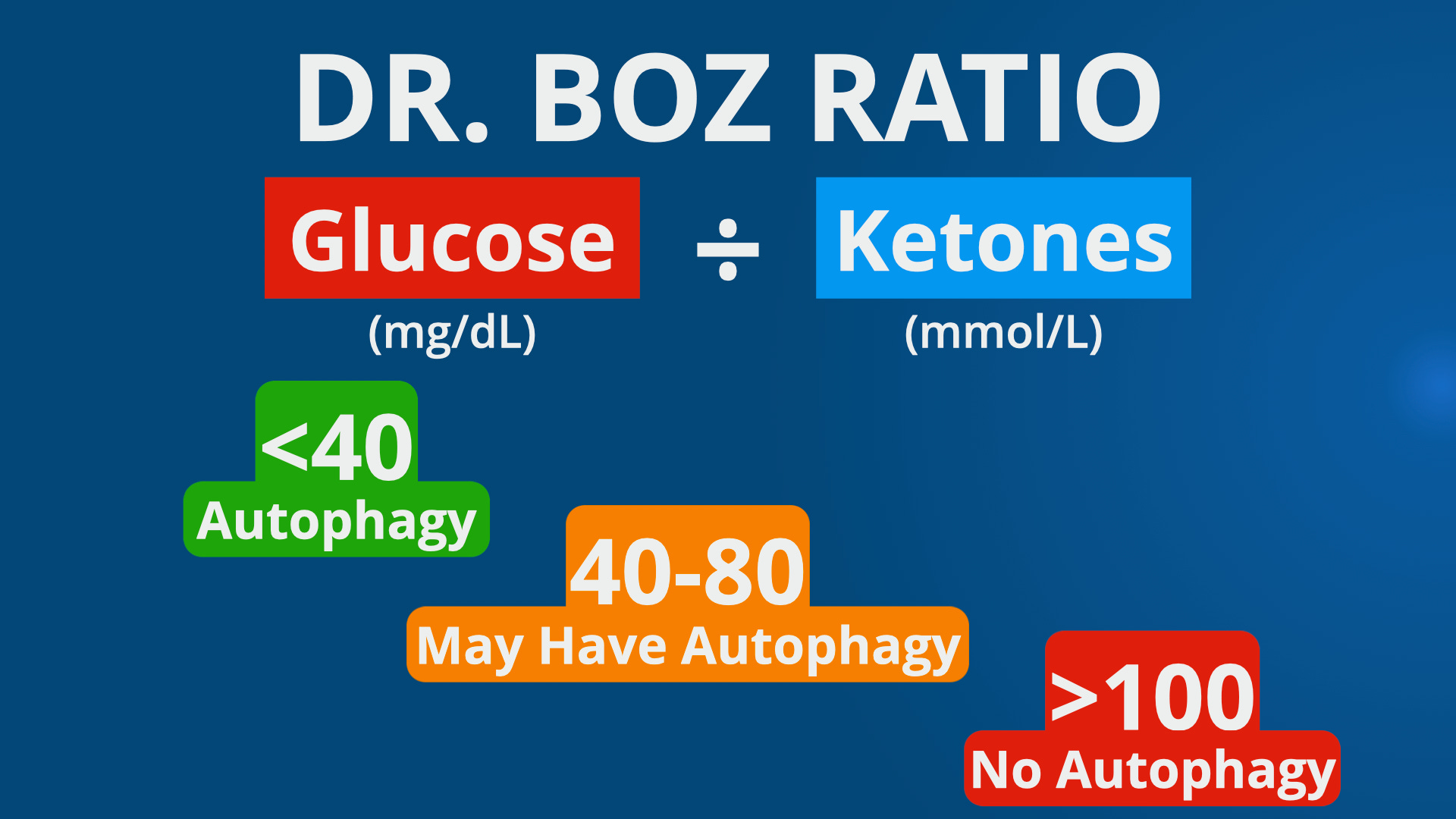
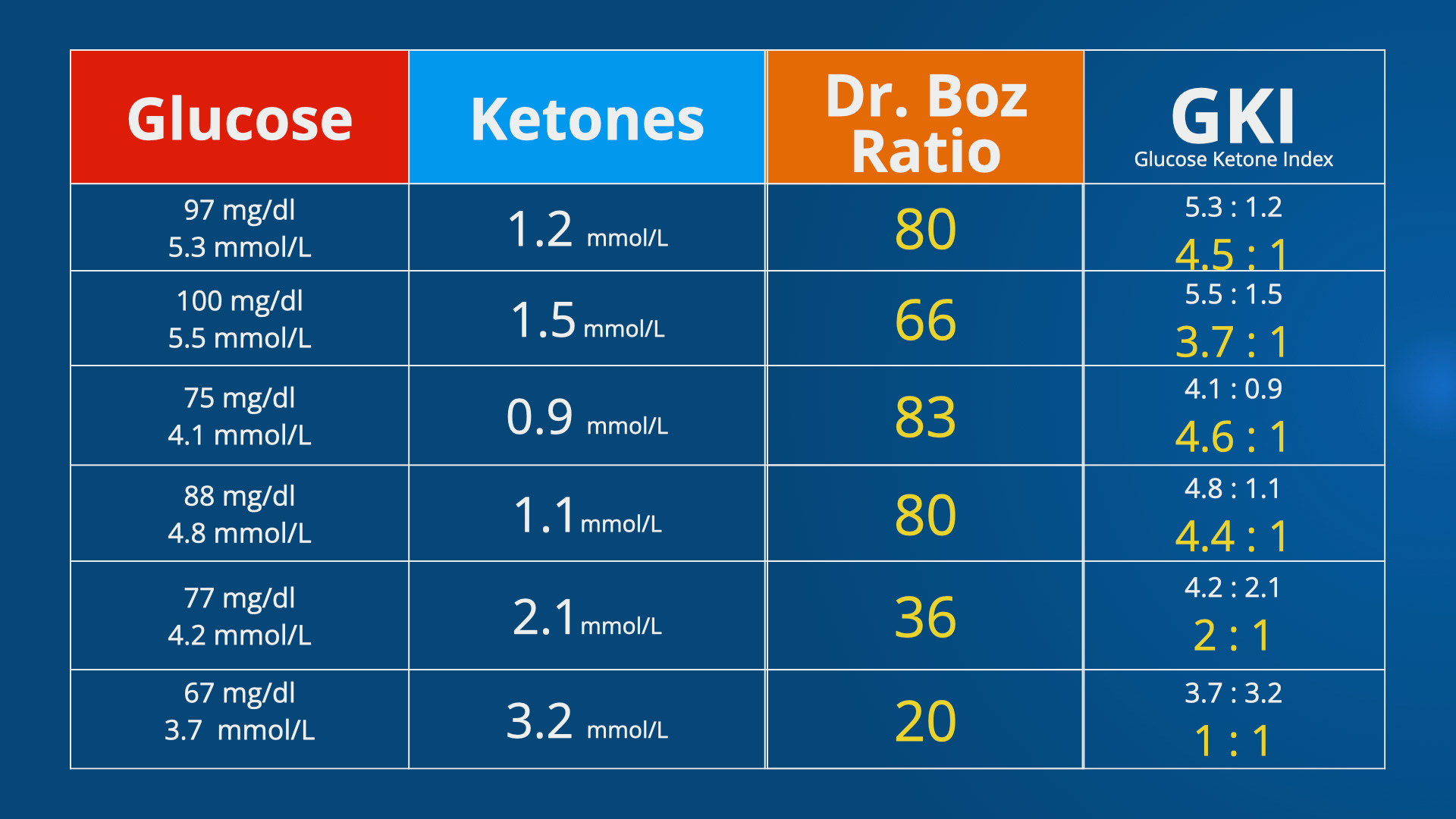
I use a simplified version of the Glucose Ketone Index (GKI) called the Dr. Boz Ratio. Divide your blood sugar by your blood ketones without converting the units. That’s your Dr. Boz ratio. It’s dirty math, and my chemistry teacher would scold me, but the simplicity of the math works great for my patients—especially for those who’s brains are like Mrs. Muted. A score over a hundred means you’re not replacing mitochondria. A score under 40 guarantees new ones.
Despite all her volatility, Mrs. Muted made enough mitochondria to be offered a seat in our extension course. She entered knowing her untapped potential.
12 Week Extension
At the end of the 21-Day bootcamp, Mrs. Muted began a microscopic dose of the GLP-1/GIP dual agonist (Tirzepatide) while continuing her ketogenic diet. Instead of the traditional beginning dose of 2.5 mg injected every week, we began at 0.6 mg per week—roughly a quarter of the normal dose.
Like most patients who’ve struggled for decades with their weight, Mrs. Muted did not lack discipline. She pricked her finger, testing her blood sugar and ketones every morning. She attended all the classes and completed all the assignments, including the most difficult task: a 72-hour water fast. Surprisingly, she rose to the top of the class and fasted for 72 hours every week. That’s impressive! For the first several weeks of this protocol, her cells remained insulin-resistant. Fat entered her mitochondria better than before the class, but the results were lackluster when looking at her effort.
During this stage of the program. Mrs. Muted’s numbers showed very little change. Each week, she successfully fasted for 72 hours. A critical metabolic breakthrough occurred deep within her cells. No one could see the slight improvement in insulin signaling in her muscle cells. No one noticed the addition of a few more mitochondria after each weekly 72-hour fast. It’s hard to appreciate any improvement when you study her graph plotting her levels of glucose and ketones. In fact, at four weeks of treatment, we increased her weekly dose from 0.6 to 0.9 mg because her glucose and ketone response was so sluggish. I blamed the booze and had little expectations of further improvement without stopping the booze. I was wrong.
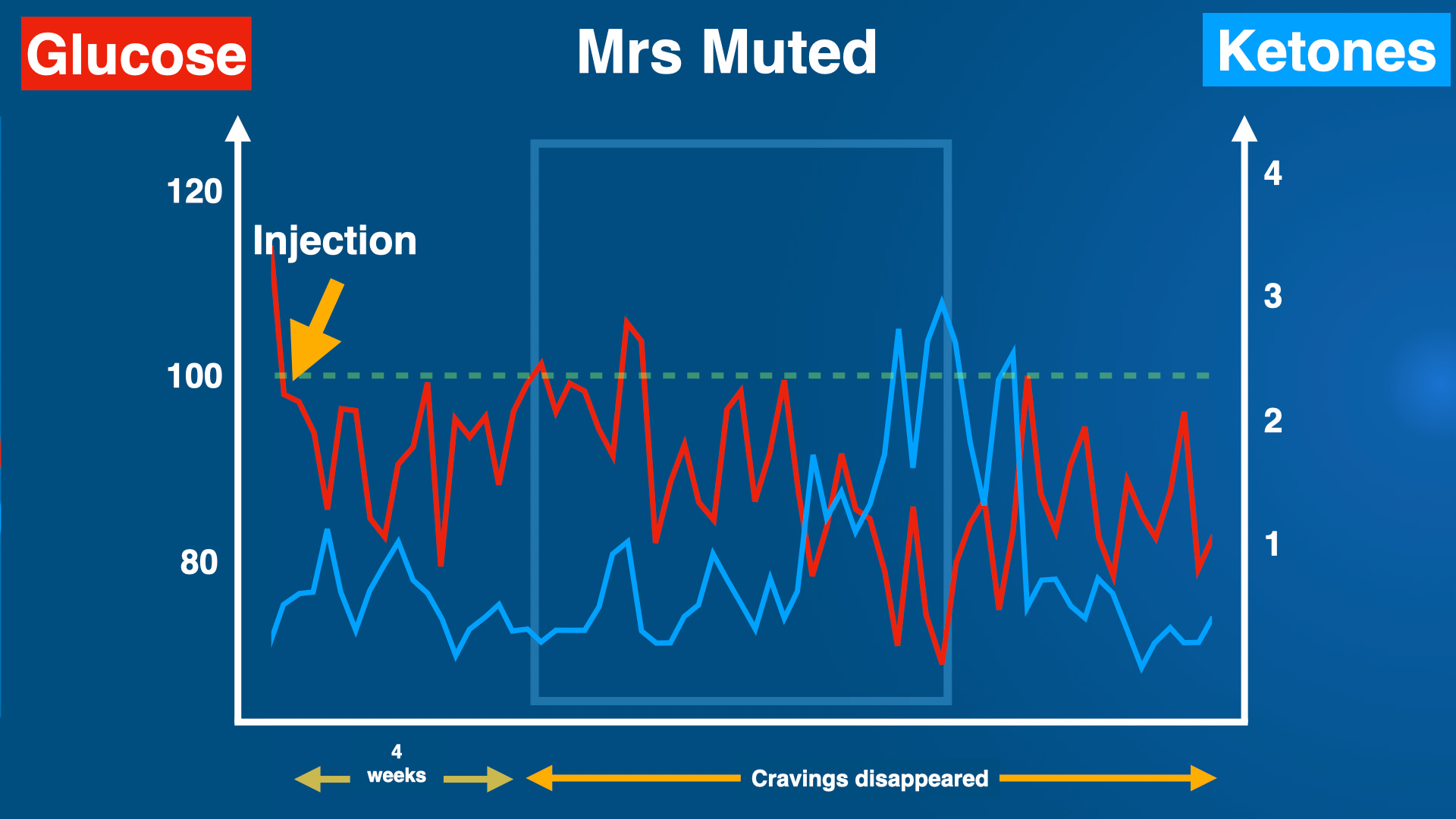
As if all of a sudden, the numbers spiked after the ninth weekly injection of tirzepatide. This significant drop in her glucose while simultaneously raising her blood ketones provided activation of her newly minted mitochondria. This flip in her numbers is all the evidence needed to know something incredible was happening.
This was when it happened. Her husband poured their traditional drink of whiskey. She joined him in their daily ritual, but her glass of whiskey went untouched. She had no desire to drink. It had vanished. This happened again the next day. And for every day since then. Unlike every other 62-year-old chronic alcohol user, she did not sink into the despair of depression lasting at least two years. Instead, she described, “For the first time in my life, I feel joy in every part of me.”
Keep reading with a 7-day free trial
Subscribe to Dr. Boz to keep reading this post and get 7 days of free access to the full post archives.